Major Arcana 5
The Hierophant: tarot card meaning
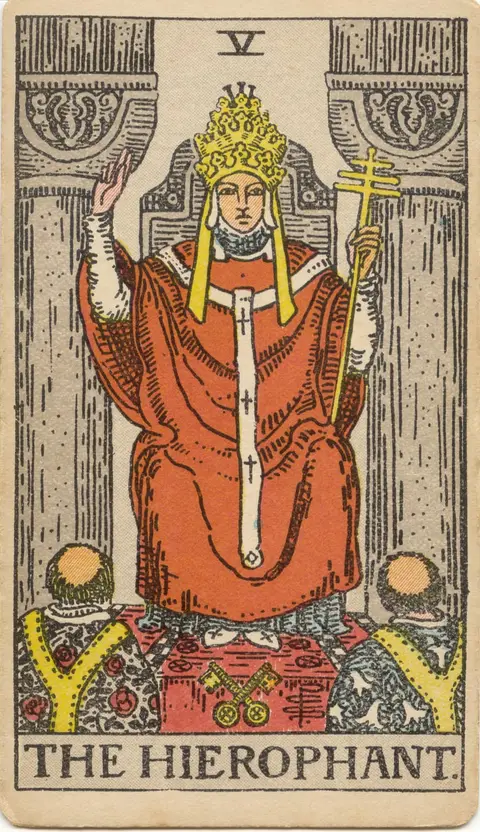
What the card shows
A figure in a red robe and a tall golden crown sits between two grey pillars, one hand raised in blessing and the other holding a staff with several crossbars. Two kneeling men with shaved crowns face him from below, and a pair of crossed golden keys lies on the floor between them.
Deck: the 1909 edition, illustrated by Pamela Colman Smith.
Upright meaning
tradition, mentorship, shared rules, belonging, inspiration
The Hierophant points to rules handed down from teacher to student. It can suggest a situation with an established way of doing things: a school, a family custom, a company handbook, a rite of passage. That structure gives support as long as you understand why it exists. The card also carries a warning, because a rule followed without thought can become a cage. Look at which norms you keep out of habit and which ones you chose yourself. Sometimes the right move is to accept the shared way, and sometimes to ask whoever guards it a direct question. It may also help to find someone to learn from.
Reversed meaning
understanding, too much leniency, questioning dogma, own path, weak footing
Reversed, the card can point in two directions. One is a better grasp of how things really work, and a readiness to look at familiar norms with your own eyes. The other is too much leniency: giving way where you should have held your ground, just to avoid arguing with someone in authority. Picture nodding along in a meeting to a decision you think is wrong, because that is how it is done. Ask which rule truly fits you and which one you put up with out of awkwardness.
In love and relationships
In love, the Hierophant often relates to shared frameworks: meeting a partner's family, talking about how you want to live together, the rituals a couple keeps, like Sunday lunch at the in-laws. It can reflect a wish for a committed bond that others recognize. Check whose expectations you are living up to: yours, your partner's, or your parents'. Shared rules help when both of you understand and agree to them.
At work
At work, this card can refer to a mentor, training, job descriptions, and the processes a team has settled on. It is a good moment to learn from someone more experienced, or to write down your own methods for others. If you lead, think about how you explain the rules to newcomers. If you report to someone, ask which parts of the process are required and which are leftovers.
A question for yourself
Which rule am I following only because it is the custom, and what does it give me?
For entertainment and reflection. The cards do not predict the future and do not replace a doctor, lawyer or financial adviser.
What tarot is: its history and why it is not a forecast
Which card is yours today?
One card a day, free and with no sign-up.
Reveal my daily card